Author: admin

  • Where to Stay in London: Three Neighborhoods, Three Perfect Hotels

    Where to Stay in London: Three Neighborhoods, Three Perfect Hotels

    Transparency note: Hotel names in this guide may link to booking partners. If you book through those links, we may earn a small commission at no extra cost to you — it keeps the guides free.

    London · Where to Stay

    Where to Stay in London: Three Neighborhoods, Three Perfect Hotels

    London is a city of villages, and your base decides how much of it you actually see. Stay near a tube line in a neighborhood with a pulse, and the whole city opens up. Here are three genuinely good bets — one for every budget.
    By the Travel Desk · Updated October 2026 · 6 min read
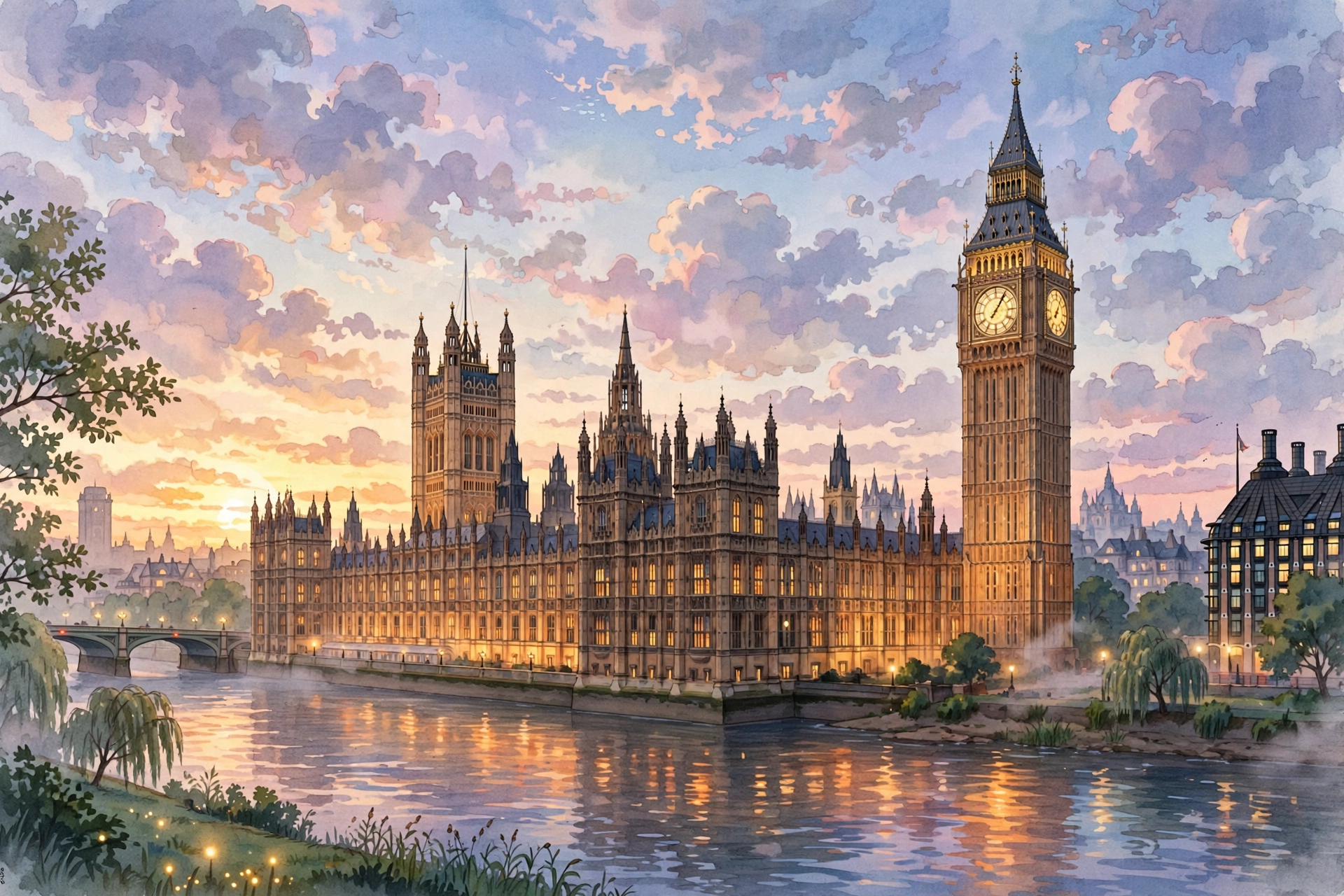
    Storybook illustration of the London skyline at dusk, with the Elizabeth Tower and the Thames glowing in warm evening light
    London at dusk — the view that makes the right hotel feel worth every penny.

    London rewards travelers who choose their base wisely. The center is vast, the tube is brilliant, and the wrong hotel can mean forty minutes each way just to get back to your room. The golden rule: stay near a tube station in a neighborhood you’d be happy to walk around at night, and let the Underground do the heavy lifting.

    Rather than a list of fifty hotels, here are three stays we’ve actually vetted — one per budget, each in a neighborhood that earns its keep. A riverside legend for the trip of a lifetime, a beloved Shoreditch favorite for the sweet spot, and a smart budget stay that keeps you near the trains.
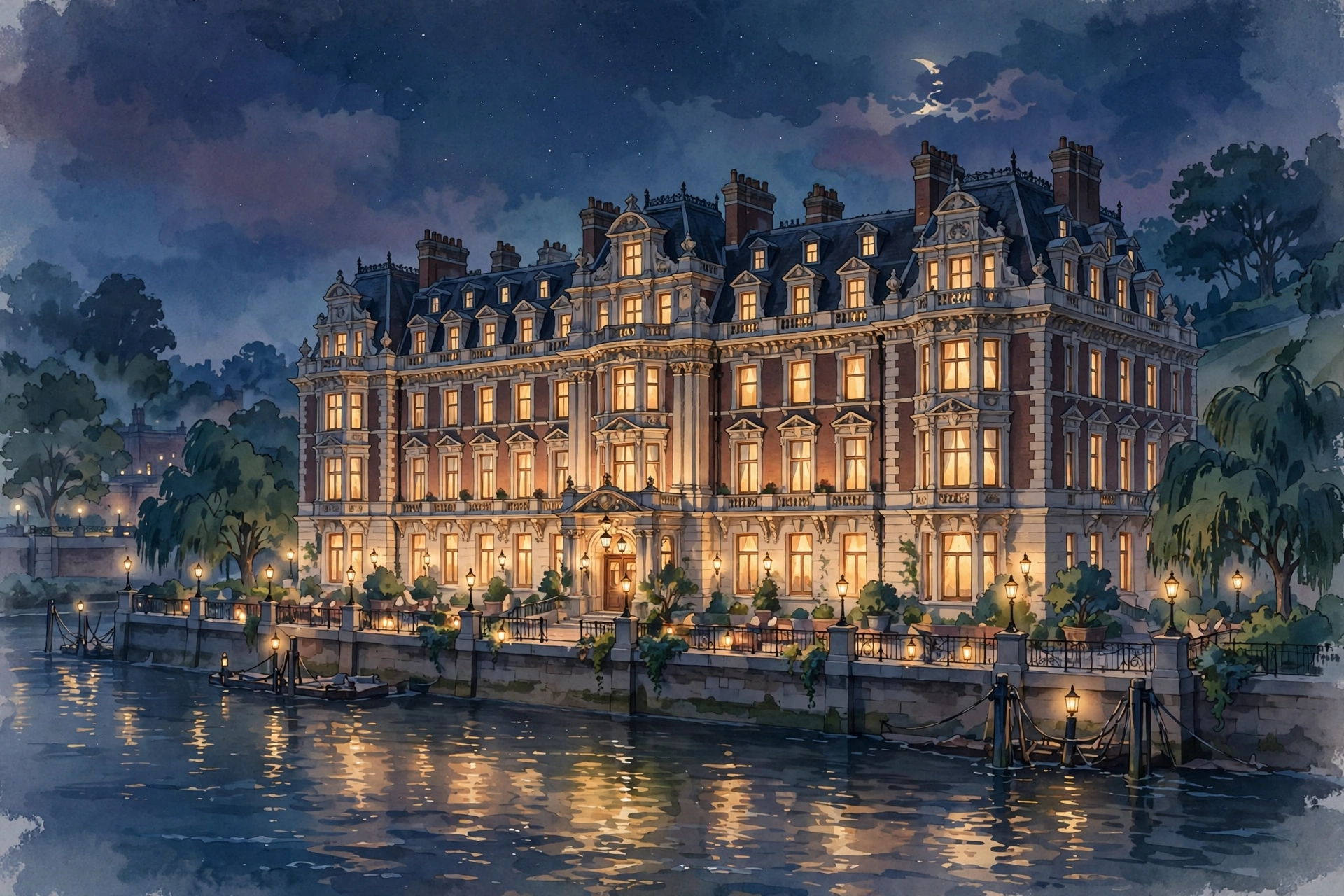
    Storybook illustration of a grand Edwardian hotel facade on the Thames at night, warm windows glowing above the riverside terrace
    Old-school glamour on the river — London does luxury like nowhere else.

    The splurge: The Savoy

    At a glance

    Neighborhood
    The Strand, between Covent Garden and the Thames
    Ideal for
    Honeymoons, anniversaries, and once-in-a-lifetime trips
    Price band
    Luxury rates, typically £500 and up per night — check current rates

    The Savoy is the grand old dame of London hotels — a five-star icon on the Strand that has been doing luxury since the 1880s, when it became the first British hotel with electric lights and electric lifts. With review scores around 4.7 out of 5 from more than 5,000 guest reviews and a Tripadvisor Travellers’ Choice award, it remains the benchmark.

    Why we’d book it:

    The location is almost unfair. The Savoy is the only luxury hotel sitting right on the River Thames, steps from Covent Garden’s theatres and the Royal Opera House, with select rooms overlooking the river itself.

    The dining is a destination. Three Gordon Ramsay restaurants — including the legendary Savoy Grill — plus the American Bar, London’s oldest cocktail bar, and a world-famous afternoon tea.

    It has a proper wellness floor. The fourth-floor wellness area holds a heated indoor pool in a bright atrium, a sauna, a steam room, and a modern gym — a rarity among historic London hotels.

    The details are immaculate. Reviewers consistently praise the service, the immaculate rooms, and touches like the bespoke Savoy Steam fragrance and a dedicated children’s welcome — it’s five-star hospitality in the truest sense.

    The sweet spot: The Hoxton, Shoreditch

    At a glance

    Neighborhood
    Shoreditch, on Great Eastern Street in creative east London
    Ideal for
    Friends’ trips, design lovers, and anyone who wants scene without the splurge
    Price band
    Mid-range, typically £140–£230 per night — check current rates

    Lonely Planet once called the original Hoxton “hands down the best hotel deal in London,” and the Shoreditch flagship still earns it: a 4-star boutique hotel with review scores around 4.5 out of 5 and a 2026 Tripadvisor Travellers’ Choice award. It sits in the middle of east London’s gallery-and-nightlife scene — and it’s about two miles from the Tower of London, which pairs nicely with our Tower of London guide.

    Why we’d book it:

    The rooftop Peruvian restaurant. The rooftop hosts the Llama Inn, a Peruvian restaurant with city views — dinner with a skyline is never a bad plan.

    It feels like a hangout, not a hotel. There’s a fashionable grill restaurant with exposed brick walls, a funky lobby bar, a library, and meeting spaces that stay lively into the evening.

    The basics are done right. Free Wi-Fi, a free breakfast bag delivered to your room, rainfall showerheads, and tea and coffee facilities — the kind of thoughtful touches mid-range hotels usually skip.

    Getting around is easy. It’s about a 6-minute walk to Old Street tube station, 12 minutes’ walk from Brick Lane’s curry houses, with bicycle rental if you’d rather pedal.

    “In London, a tube station nearby beats a star rating every single time.”

    — The Travel Desk
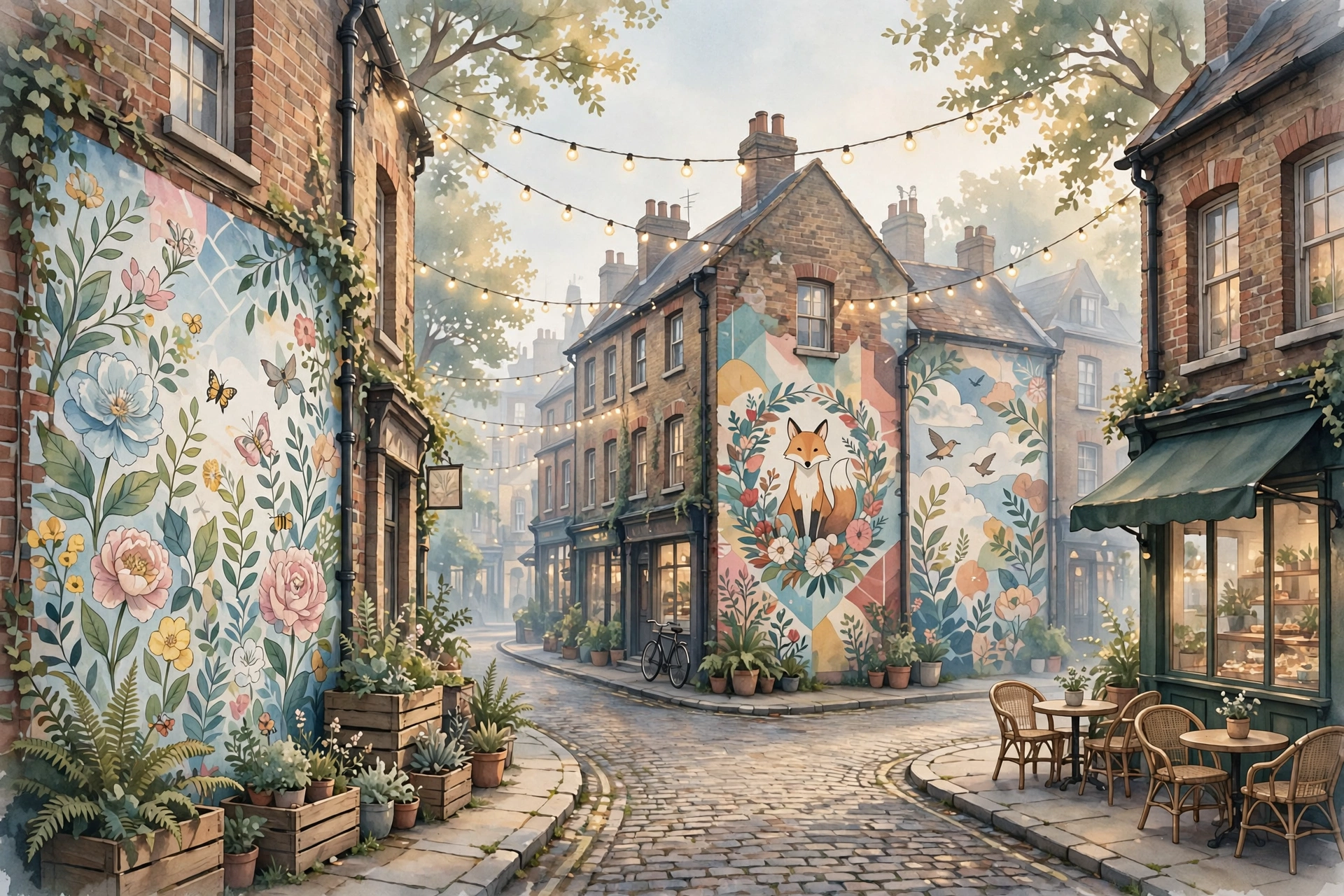
    Storybook illustration of a Shoreditch street in morning light, colorful street-art murals on brick buildings and a quiet cafe corner
    Shoreditch in the morning — galleries, murals, and some of London’s best coffee.

    The smart save: Point A Hotel London Kings Cross – St Pancras

    At a glance

    Neighborhood
    Kings Cross, steps from St Pancras International
    Ideal for
    Budget travelers, rail arrivals, and anyone who’d rather spend money out in the city
    Price band
    Budget — typically £80–£160 per night — check current rates

    Point A calls itself “budget boutique,” and the Kings Cross outpost backs it up: a rating of 8.0 from roughly 25,000 guest ratings, with guests praising the friendly staff and the breakfast. The rooms are compact by design — the cheapest are even windowless — but everything is crisp, modern, and comfortable.

    Why we’d book it:

    The location is a transport dream. It’s a short walk from King’s Cross and St Pancras stations — six tube lines, national rail, and the Eurostar. Arrive by train and you’re basically at the hotel in minutes.

    The essentials are excellent. Hypnos beds, power showers, air conditioning, free high-speed Wi-Fi, express self-service check-in, and a 24-hour reception — the things that actually determine how well you sleep.

    It punches above its price. There’s a bar, a well-reviewed breakfast buffet, luggage storage, and late check-out available — more than you’d expect at this price in central London.

    A fair warning from reviewers: ask for a higher-floor room away from the street for the quietest nights.
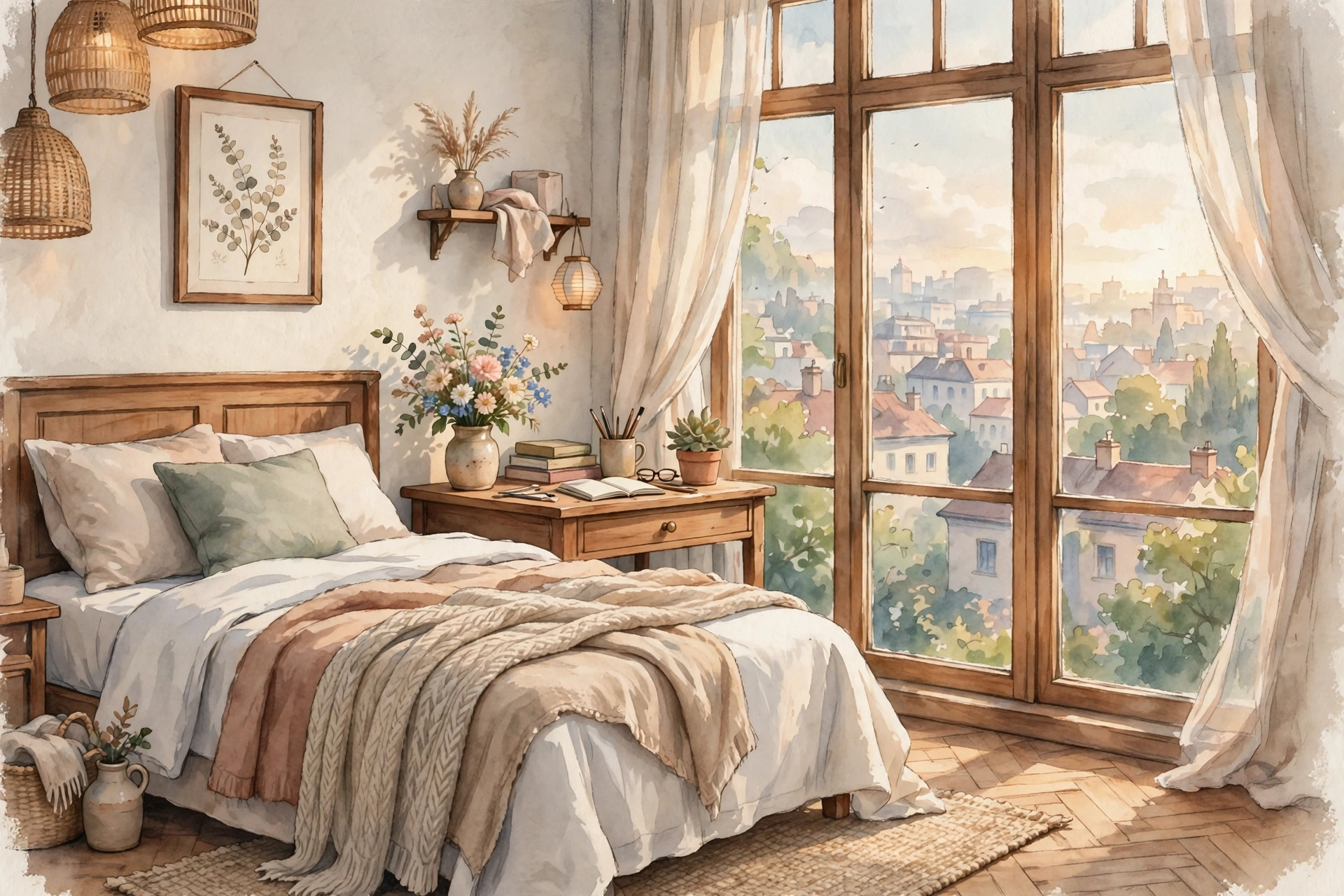
    Storybook illustration of a cozy boutique hotel bedroom in warm morning light, with a window framing a soft cityscape view
    The real test of a London hotel: a great bed and a window worth opening.

    Booking tips for London

    1. Stay in Zone 1 or 2, near a tube line The tube is fast and frequent, but only if you’re near it. Any hotel within a few minutes’ walk of a station in Zones 1–2 puts the whole city within 30 minutes. A “cheap” hotel in Zone 4 will cost you an hour of your day, every day.
    2. Pick your neighborhood by trip type First-timers: Covent Garden, South Kensington, or Bloomsbury for walkable sights. Nightlife and design: Shoreditch or Soho. Value and transport: Kings Cross or Paddington. Choose vibe first — the tube handles the rest.
    3. Book summer early, winter late London sells out and prices spike from June through September. Book two to three months ahead for summer; in winter you can often grab deals weeks out. Check whether breakfast is included before comparing prices — it can swing the real cost by £20–£40 a day.

    Where to stay in London: FAQ

    What’s the best area for a first-time visitor?

    Covent Garden, South Kensington, or Bloomsbury. You’ll be walking distance to major sights, on good tube lines, and surrounded by restaurants that stay open late. Shoreditch is the pick if you’d rather have nightlife and street art on your doorstep.

    Is it worth staying near the Tower of London?

    Not necessarily. The Tower is easy to reach by tube from anywhere central — Shoreditch is about two miles away, and Kings Cross gets you there on the Circle line with no changes. Stay where you’ll enjoy your evenings, not just your sightseeing.

    How far in advance should I book?

    For June through September, book two to three months ahead — the best-located rooms go first and prices climb. In the off-season, a few weeks out is usually fine, and winter brings the year’s best rates.

    Do I need to worry about a tourist tax?

    London doesn’t currently charge a tourist tax, but hotels do add VAT (usually included in the displayed price) and some charge a refundable deposit at check-in. Always check whether the rate you see is the rate you pay.

    Affiliate disclosure: This post may contain affiliate links, including hotel booking links. If you book through them, we may earn a commission at no additional cost to you. We only recommend stays we’d genuinely book ourselves.

    Illustrations in this post are original artwork in a dreamy animated style.

  • The Tower of London: Crown Jewels, Ravens & a Thousand Years of Stories

    The Tower of London: Crown Jewels, Ravens & a Thousand Years of Stories

    Transparency note: This guide contains an affiliate link to GetYourGuide. If you book through it, we may earn a small commission at no extra cost to you — it keeps the guides free.

    London · Tower of London

    The Tower of London: Crown Jewels, Ravens & a Thousand Years of Stories

    Nine centuries of kings, prisoners, and plot twists stand behind one set of stone walls. Here’s how to see the very best of it — the jewels, the Beefeaters, the ravens — in a single, well-planned visit.

    By the Travel Desk · Updated October 2026 · 7 min read
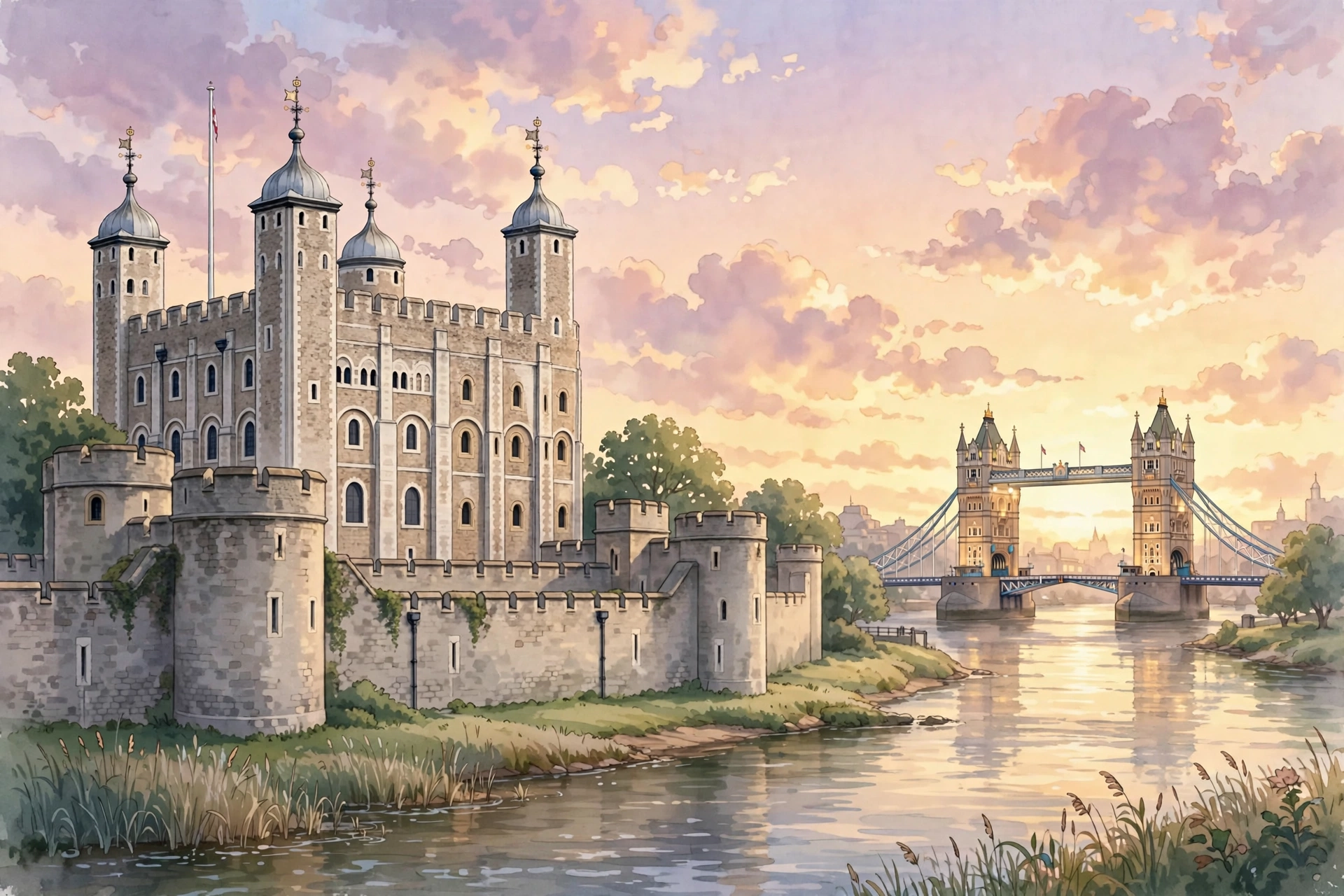
    Storybook illustration of the Tower of London's stone keep and walls at golden hour, with Tower Bridge glowing in the distance across the Thames
    The Tower at golden hour — fortress, palace, prison, and the best stories in London.

    There is no building in London quite like the Tower. Built in the 1080s by William the Conqueror, this UNESCO World Heritage Site has spent nearly a thousand years as a royal palace, an infamous prison, a royal menagerie, and the vault that guards the Crown Jewels. Walking through the gates feels less like entering a museum and more like stepping into a thousand years of plot twists.

    The smart way to visit is simple: book your ticket online in advance, arrive early, and head straight for the Crown Jewels before the crowds build. This guide covers exactly what’s included with your ticket, what to see in what order, and the practical details that make the day smooth.

    At a glance

    Allow
    3 to 4 hours — this is a half-day, not a quick stop
    Entry
    West Entrance via Tower Hill — show your ticket on your phone
    Getting there
    Tower Hill is the nearest Underground station, minutes away on foot
    Cancellation
    Full refund when you cancel at least 24 hours before your visit

    What your ticket includes

    This is the Tower of London and Crown Jewels Exhibition Ticket — full entry to the Tower grounds, the White Tower, and the Crown Jewels display. The Yeoman Warder (Beefeater) guided tours are included in admission: they set off roughly every 30 minutes from the moat, are given in English, and run first-come, first-served — no advance booking for the tour itself. Just check the day’s times on the boards when you enter.

    A note from the fine print: during busy periods you can still expect some queues for the Crown Jewels themselves, and there’s no re-entry once you leave. Multi-language audio guides are available at the Tower for an additional fee if you’d rather explore at your own pace.

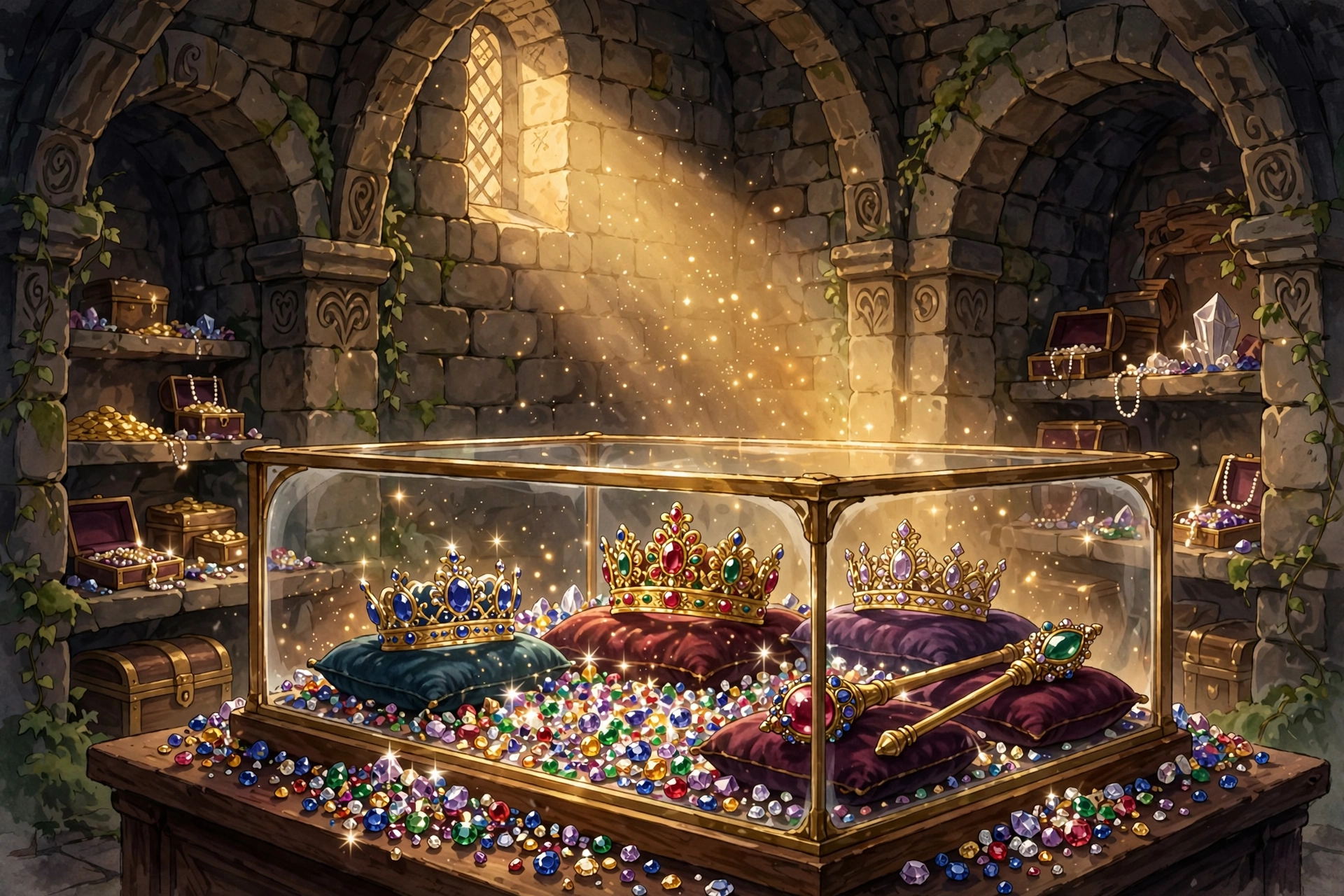
    Storybook illustration of a jewel vault glowing with golden light, ornate jeweled crowns resting on velvet cushions inside a glass case
    The Crown Jewels — the greatest working collection of crown jewels in the world.

    The Crown Jewels first

    Do the Jewel House before anything else. The queue is shortest in the first half hour after opening and grows steadily through the morning. Inside, you’ll glide past the coronation regalia on a moving walkway — including the Imperial State Crown, which alone carries 2,868 diamonds, 273 pearls, 17 sapphires, 11 emeralds, and 5 rubies. In total the collection holds 23,578 gems, and it is still used in royal ceremonies today. Photography isn’t allowed inside the exhibition, so look with your eyes, not your lens.

    The White Tower, the ravens, and the Beefeaters

    After the jewels, climb the White Tower — the 11th-century Norman keep at the heart of the fortress — for the Royal Armouries collection of arms and armor, then tiptoe through a reconstructed medieval bedchamber. Outside, the Yeoman Warders (the famous Beefeaters) bring the Tower’s bloodiest tales to life on their free guided tours; they meet by the moat and are worth planning your morning around.

    Then walk Tower Green, the quiet lawn where many executions took place — including two of Henry VIII’s wives — and look for the Tower’s ravens, whose presence is said to guard the kingdom itself. Legend says that if the ravens ever leave, the Tower will fall.

    “Arrive early, do the jewels first, then let the Beefeaters tell you the stories.”

    — The Travel Desk
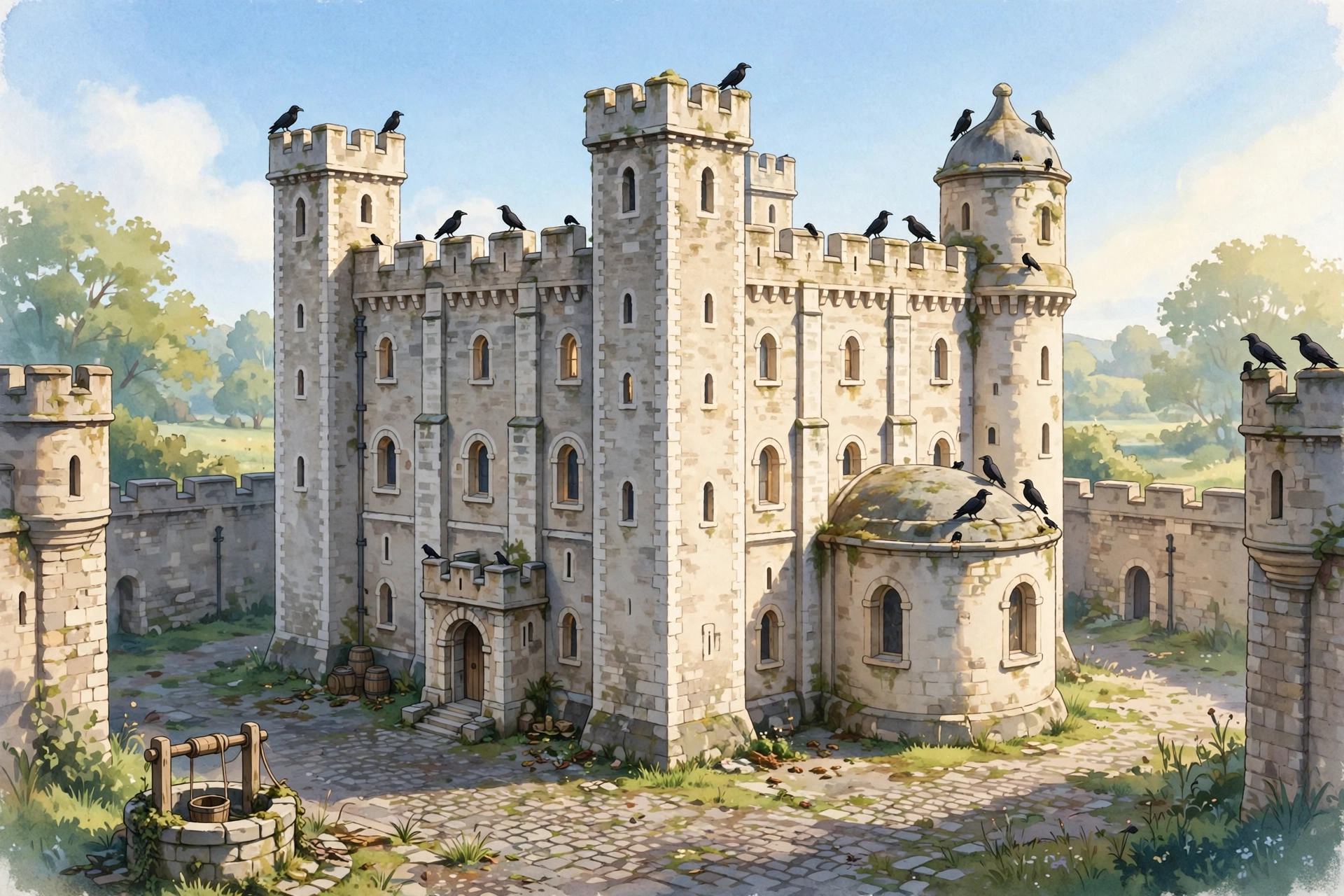
    Storybook illustration of the White Tower keep in bright morning light, with black ravens perched on the ancient battlements
    The White Tower — William the Conqueror’s keep — with its resident ravens on watch.

    Tips for a smooth visit

    1. Arrive in the first 30–45 minutes The Crown Jewels attract the longest queues all day. Entering close to opening time usually means a relaxed visit and far shorter waits at the Jewel House.
    2. Catch a Beefeater tour early The Yeoman Warder talks start regularly through the day from the moat and are included with your ticket. Join one early — it orients the whole visit and the stories are the highlight.
    3. Pack light and wear good shoes Everyone passes through airport-style security, and large luggage isn’t allowed inside. The grounds mean cobblestones, spiral staircases, and uneven stone floors — comfortable shoes are non-negotiable.
    4. Come by public transport Tower Hill Underground station is only a few minutes’ walk away. Driving into central London means congestion charges, traffic, and expensive parking.
    Storybook illustration of Tower Green at soft dusk, with the Chapel of St Peter ad Vincula and historic cannons glowing in warm lamplight
    Tower Green at dusk — the quietest corner of a thousand years of history.

    Tower of London: FAQ

    Is the Crown Jewels exhibition really included in the ticket?

    Yes — the ticket is specifically the Tower of London and Crown Jewels Exhibition ticket, so the Jewel House is included in your entry. Do it first thing: the queue there is the longest in the Tower and builds quickly after opening.

    Are the Beefeater tours extra?

    No. The Yeoman Warder tours are included in admission and leave roughly every 30 minutes from the moat. They’re given in English only and can’t be booked in advance — just check the meeting point and times on the boards when you arrive.

    How long should I plan for?

    Allow 3 to 4 hours to see the Crown Jewels, the White Tower, a Beefeater tour, Tower Green, and the battlements comfortably. Some visitors rush it in two hours, but you’ll miss the best stories that way.

    Can I leave and come back in later?

    No — there is no re-entry once you leave the Tower, so plan to see everything in one visit. Eat and use the restrooms before you exit.

    What’s the cancellation policy?

    You can cancel for a full refund up to 24 hours before your visit. Within 24 hours, tickets are non-refundable.

    Affiliate disclosure: This post contains an affiliate link to GetYourGuide for the Tower of London ticket. If you book through it, we may earn a commission at no additional cost to you. We only recommend experiences we’d book ourselves.

    Illustrations in this post are original artwork in a dreamy animated style.

  • Where to Stay in Amsterdam: Three Neighborhoods, Three Perfect Hotels

    Where to Stay in Amsterdam: Three Neighborhoods, Three Perfect Hotels

    Transparency note: Hotel names in this guide may link to booking partners. If you book through those links, we may earn a small commission at no extra cost to you — it keeps the guides free.

    Amsterdam · Where to Stay

    Where to Stay in Amsterdam: Three Neighborhoods, Three Perfect Hotels

    Amsterdam is a city of neighborhoods, and where you sleep shapes the trip you get. Stay on the canals and the city glows at your window; stay in the east and it hums with creative energy. Here are three real favorites — one for every kind of trip.

    By the Travel Desk·Updated October 2026·6 min read
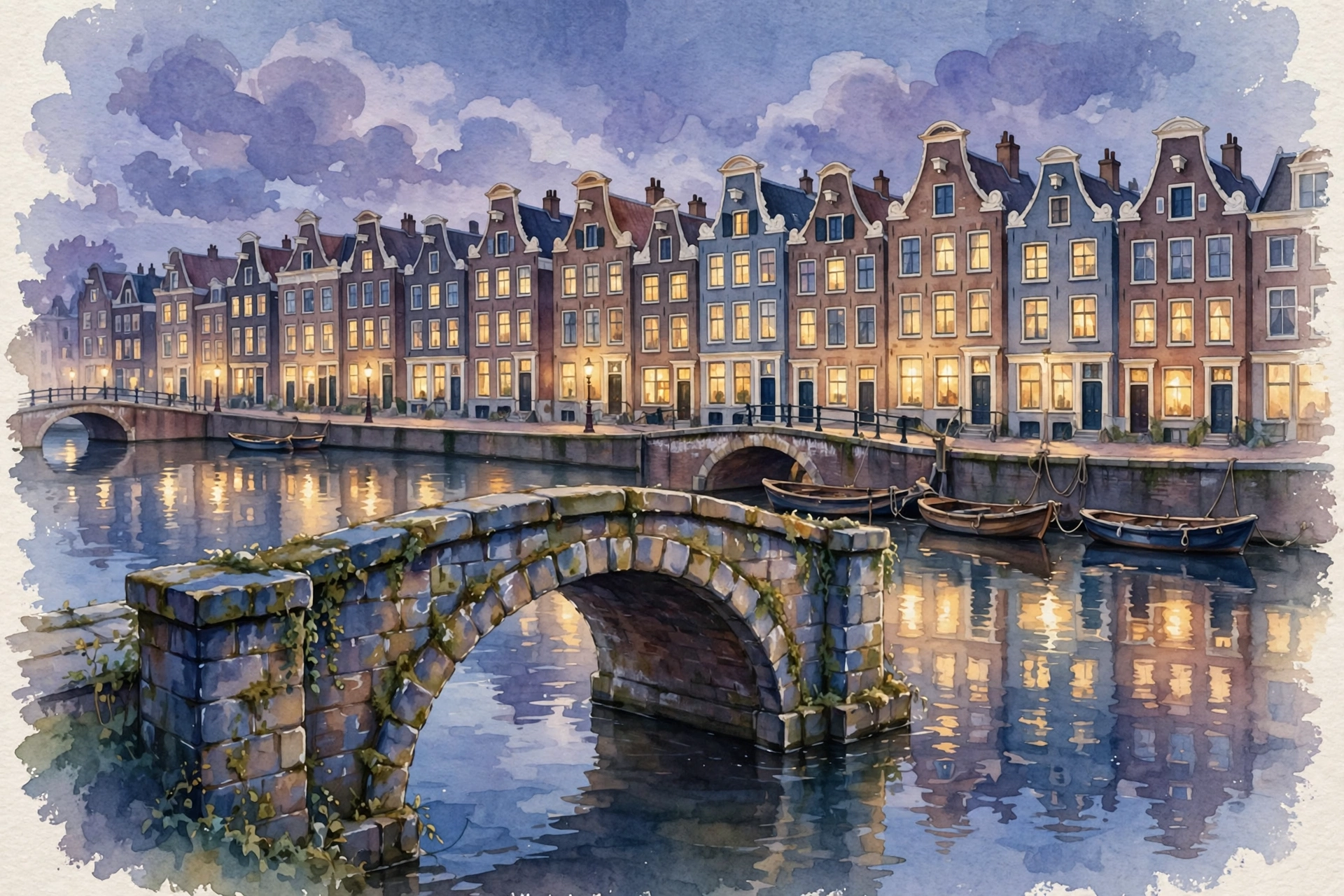
    Storybook illustration of Amsterdam canal houses with stepped gables at blue hour, glowing windows reflected in the canal beside an arched stone bridge
    Blue hour on the canals — this is the view worth choosing your hotel around.

    Amsterdam rewards travelers who pick their base well. The center is compact — you can walk from the Jordaan to the museums in under half an hour — but each neighborhood has its own rhythm, and the wrong base can mean long tram rides back to a room that doesn’t feel like the city at all.

    So instead of a list of fifty hotels, here’s something better: three stays we’ve actually vetted, one per budget, each in a neighborhood that earns its keep. A canal-side splurge for the trip of a lifetime, a lively mid-range favorite in the creative east, and a genuinely charming budget stay that punches far above its price.

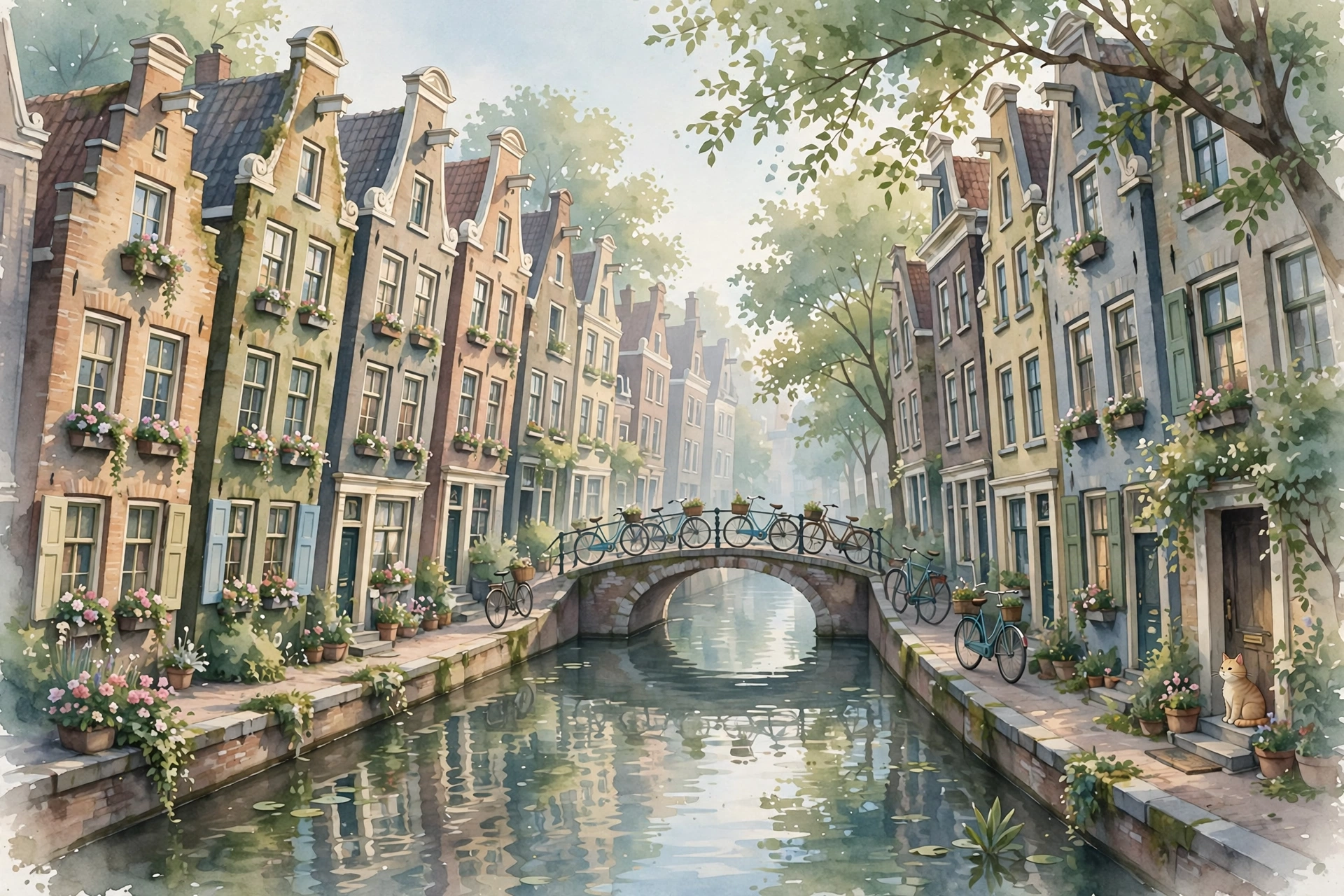
    Storybook illustration of a quiet Jordaan canal street in morning light, with leaning gabled houses, bicycles on a small bridge, and flower boxes
    The Jordaan at first light — quiet streets, leaning houses, and bicycles everywhere.

    The splurge: Pulitzer Amsterdam

    At a glance

    Neighborhood
    Nine Streets, on the Prinsengracht (canal belt)
    Ideal for
    Honeymoons, anniversaries, and once-in-a-lifetime trips
    Price band
    Luxury rates, typically €400 and up per night — check current rates

    The Pulitzer isn’t a hotel so much as a small village: 25 interlinked 17th- and 18th-century canal houses woven together into one labyrinthine property on the Prinsengracht. The corridors wind, the staircases surprise, and half the fun is getting a little lost on the way to your room.

    Why we’d book it:

    You sleep inside history. Exposed beams, timber floors, and Dutch-tiled bathrooms make rooms feel like the canal houses they are — while the beds, bathrooms, and service are firmly five-star. Ask for a canal-view room; watching boats drift past from your window is the whole point.

    The inner garden is a secret. Behind the facades sits a tranquil courtyard garden with a café — one of those rare quiet pockets in the middle of the old center, perfect for a slow morning coffee.

    It has its own canal boat. The Pulitzer’s 1909 saloon boat, The Tourist, runs private canal cruises — the natural pairing for our evening canal cruise guide. Few hotels in the world can put you on the water in a century-old vessel from your own lobby.

    Dinner is sorted. Jansz, the all-day restaurant, is one of the better hotel restaurants in the city, and Pulitzer’s Bar does a serious cocktail program in an intimate, jewel-toned room.

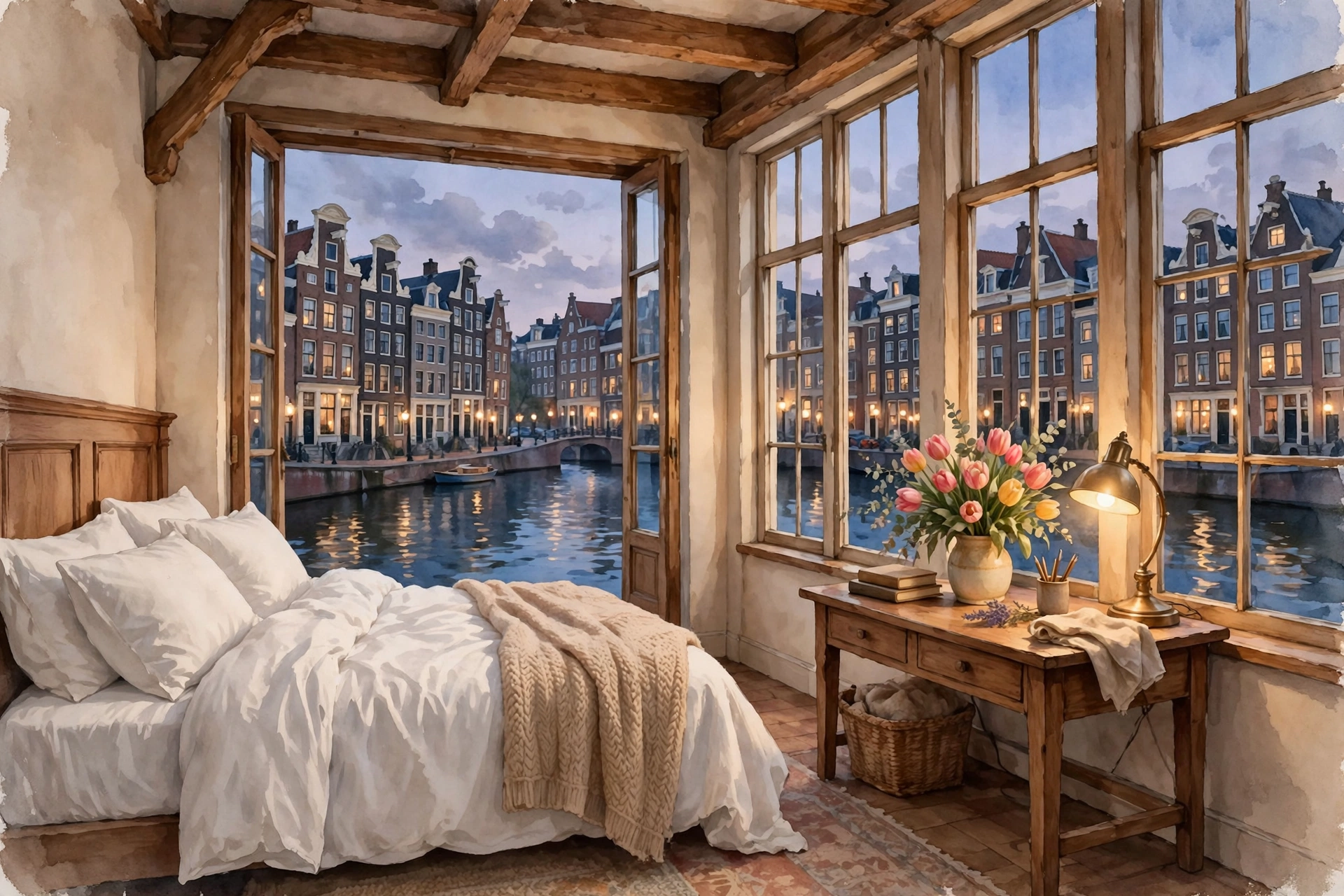
    Storybook illustration of a cozy hotel bedroom with tall windows framing a canal view at dusk, tulips on the desk, warm lamplight
    The reason to splurge: waking up with the canal outside your window.

    The sweet spot: Volkshotel

    At a glance

    Neighborhood
    Amsterdam-Oost (Wibautstraat), the creative east
    Ideal for
    Friends’ trips, creative travelers, and anyone who wants scene without the splurge
    Price band
    Mid-range, typically €90–€180 per night — check current rates

    Set in the former headquarters of the Volkskrant newspaper, the Volkshotel is the rare mid-range hotel that feels like a destination in itself. The industrial bones are still there — raw concrete, big windows, artist-designed rooms — but the energy is all play.

    Why we’d book it:

    The rooftop is the best seat in the east. Canvas, the 7th-floor restaurant and sky bar, serves dinner with 360-degree city views and turns into a club with DJs on weekend nights. One floor up, the rooftop spa has wooden hot tubs and a sauna overlooking the skyline — sunset from a hot tub is a core Amsterdam memory.

    There’s always something on. The Doka basement club hosts live music and DJ sets, the lobby’s Werkplaats hums with freelancers and good coffee, and the whole building runs like a small creative village rather than a hotel.

    Getting around is effortless. The Wibautstraat metro station is about 50 meters away, putting Amsterdam Centraal under ten minutes away, and the hotel rents bikes — the Amstel river is two minutes’ ride, the lively De Pijp five.

    With a review score around 8.9 from more than ten thousand guest reviews, it’s one of the most consistently loved mid-range stays in the city.

    The charmer: Cocomama

    At a glance

    Neighborhood
    Border of De Pijp, near Museumplein and the Albert Cuyp market
    Ideal for
    Budget travelers, solo travelers, and social first-timers
    Price band
    Budget — dorm beds typically €25–€60 per night, private rooms more — check current rates

    Cocomama calls itself Amsterdam’s first boutique hostel, and it earns the title. Set in a grand old canal-side building on the edge of De Pijp — once a brothel, now thoroughly reformed — it’s the kind of place that makes budget travel feel like a choice rather than a compromise.

    Why we’d book it:

    The rooms have personality. Each room carries a Dutch theme — Delft blue, tulips, canal houses — and the building’s bones (lofty ceilings, marble entry, chandeliers) survived the renovation beautifully. Dorms are comfortable with privacy curtains; private doubles exist but book out fast.

    The location is quietly perfect. Close enough to walk to the Museumplein and the Rijksmuseum, steps from the Albert Cuyp street market and the Heineken Experience, in a residential pocket that stays calm when the center gets loud.

    It feels like a home, not a hostel. There’s a bright communal living room, a guest kitchen, a hidden back garden, an honor bar, movie nights, affordable bike rentals, and a famously friendly resident cat. The staff’s restaurant recommendations alone are worth the stay.

    “In Amsterdam, location beats star rating every single time.”

    — The Travel Desk
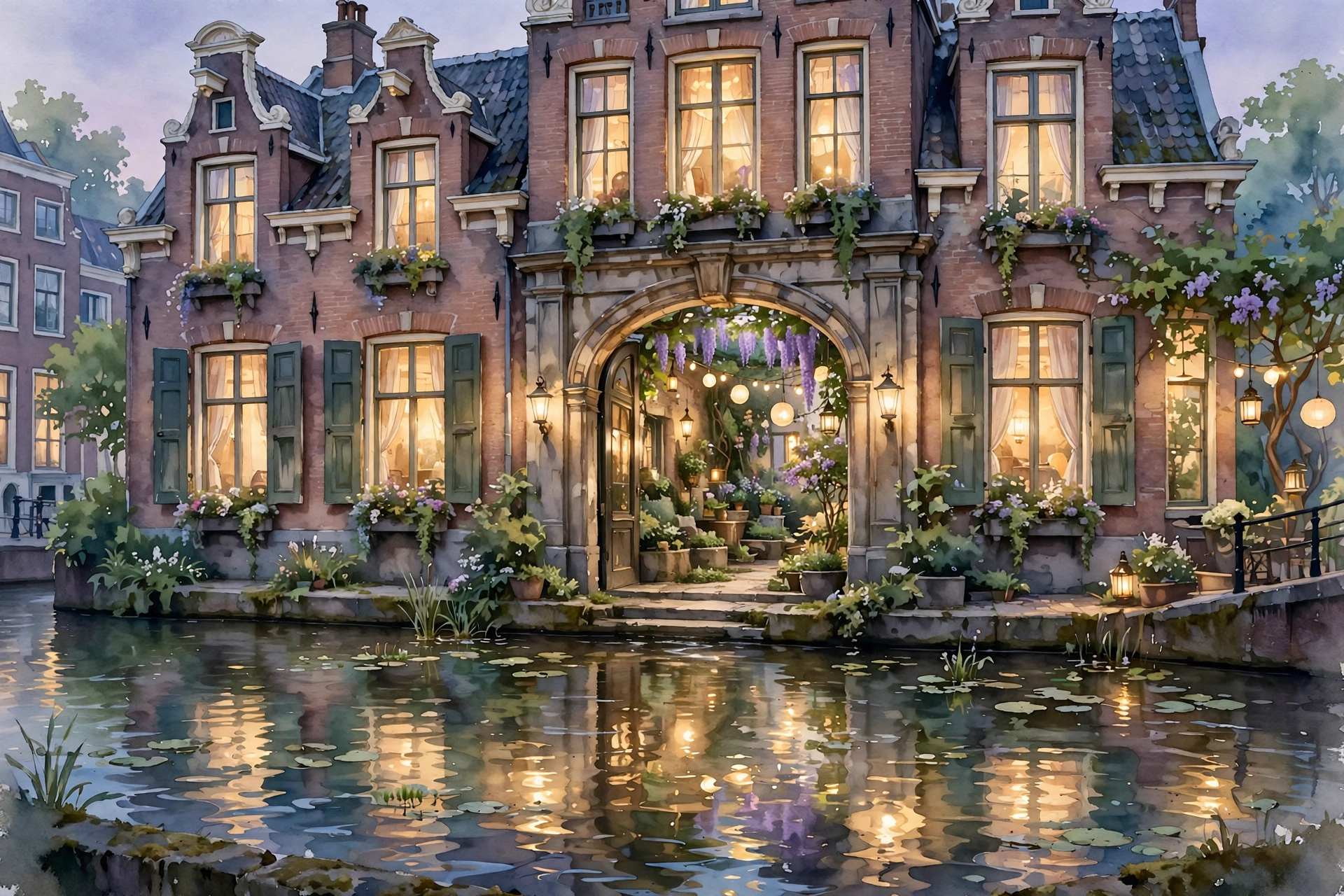
    Storybook illustration of a grand canal-house hotel facade at dusk, warm windows glowing above an archway opening onto a lantern-lit inner garden courtyard
    Behind many canal facades hides a quiet courtyard — one more reason to stay central.

    Booking tips for Amsterdam

    1. Book canal-view rooms earlyThe rooms everyone wants — canal-facing, upper floors, quiet side of the building — are also the fewest. For spring and summer trips, lock these in months ahead; they’re the first to sell out and the last to discount.
    2. Budget for the tourist taxAmsterdam levies one of the highest tourist taxes in Europe, charged per person per night on top of the room rate. It won’t break the trip, but it does add up — factor it in before comparing prices across cities.
    3. Choose location over starsA well-located three-star near the canals beats a four-star out by the highway. In Amsterdam you spend your days walking, cycling, and boating — every tram ride back to a far-flung hotel is time not spent on the water.

    Where to stay in Amsterdam: FAQ

    What’s the best area for a first-time visitor?

    The canal belt — the Nine Streets, the Jordaan, or anywhere along the Prinsengracht, Keizersgracht, or Herengracht. You’ll be walking distance to the Anne Frank House, the museums are a short tram ride, and the evening canal views are free. De Pijp is the best alternative if you want livelier nightlife and slightly better value.

    How far in advance should I book?

    For April through September, book two to three months ahead for the best pick of rooms — canal-view rooms go first. In winter, a few weeks is usually fine, and you’ll find the year’s best rates. King’s Day (late April) and major conferences sell the city out entirely, so book those dates as early as you can.

    Is a canal-view room worth the extra cost?

    For a special trip, yes — it’s the difference between staying in Amsterdam and staying near it. For shorter or budget trips, a courtyard or street-side room in a great neighborhood gives you 90% of the experience; you’ll be out on the canals during the day anyway.

    Do I need to stay near Centraal Station?

    No. The station area is convenient for arrivals but isn’t where you want to spend your evenings. Anywhere along a metro or tram line within the ring — the canal belt, De Pijp, Oost, or Oud-West — gets you to Centraal in under 15 minutes while putting you in a far nicer neighborhood.

    Affiliate disclosure: This post may contain affiliate links, including hotel booking links. If you book through them, we may earn a commission at no additional cost to you. We only recommend stays we’d genuinely book ourselves.

    Illustrations in this post are original artwork in a dreamy animated style.

  • Amsterdam Evening Canal Cruise: The Complete Guide

    Amsterdam Evening Canal Cruise: The Complete Guide

    Amsterdam · Travel Guide

    As the streetlamps flicker on and the bridges light up, Amsterdam trades its bustle for something quieter and far more romantic. Here is how to do the evening cruise right — what you will see, what you will sip, and the small choices that make a great night unforgettable.

    By the Travel Desk · Updated October 2026 · 8 min read

    Transparency note: This post contains affiliate links. If you book through our links, we may earn a small commission at no extra cost to you — it keeps the guides free.

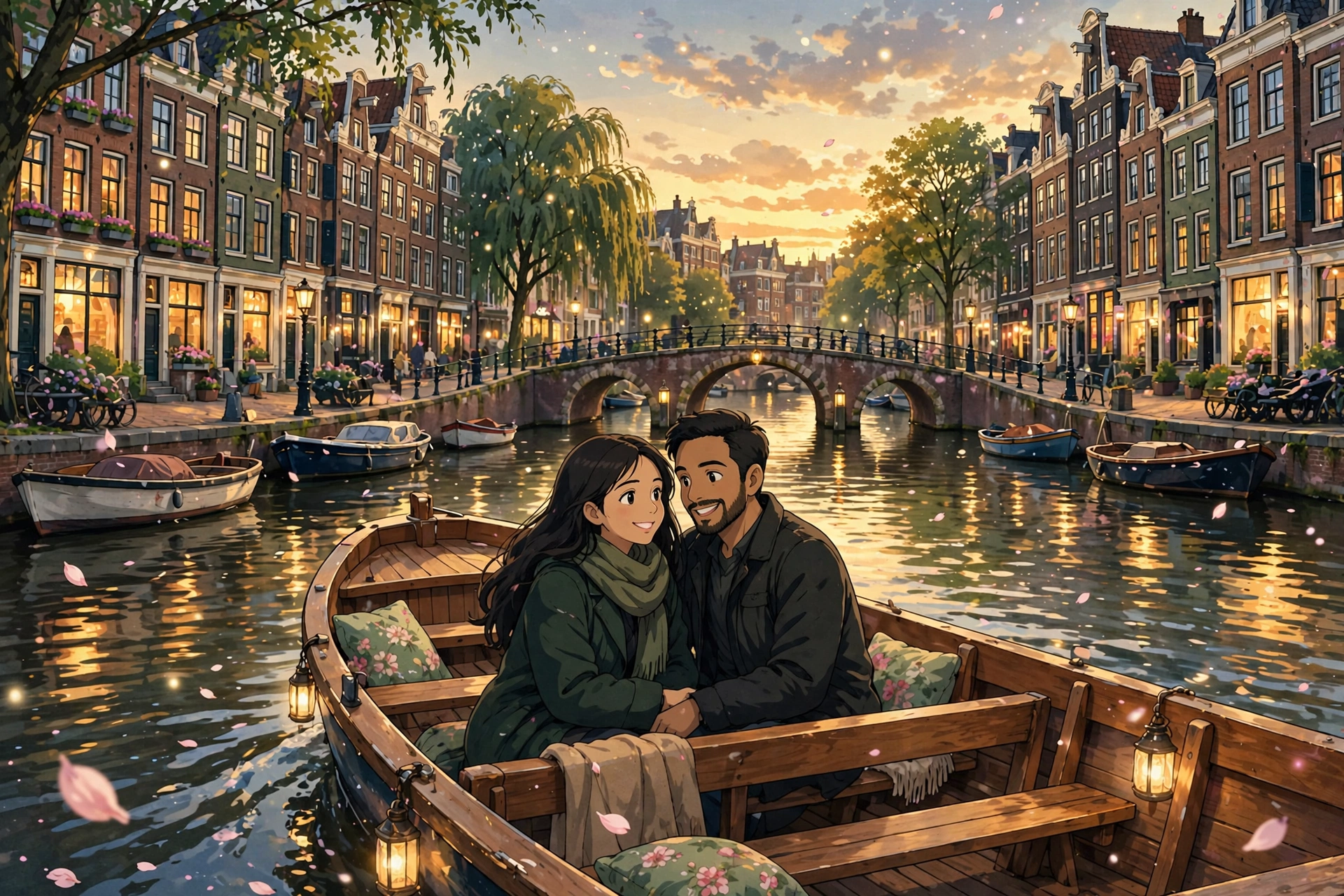
    Illustration of a couple gliding down an Amsterdam canal in a wooden boat at sunset, past glowing canal houses and an arched stone bridge
    Golden hour on the canals — the hour the whole city seems to slow down.

    There is a specific moment, usually about twenty minutes into an evening cruise, when the city catches you off guard. The guide softens their voice, the boat slips under a bridge strung with lights, and the canal does that doubling trick — every lit window reflected perfectly in the water below. Daytime Amsterdam is charming. Nighttime Amsterdam is something else entirely.

    Of all the ways to see the city after dark, the evening canal cruise is the one we would never skip. This guide covers everything you need to know before you book: why the evening sailing beats the daytime version, what to expect on the route, what is served on board, and the small booking tips that separate a good night from a great one.

    Why the evening cruise is the one to take

    Amsterdam’s canals are beautiful at any hour, but they were made for twilight. Around sunset the crowds thin, the light goes amber, and the city’s famous bridge lights switch on one by one — nearly two hundred of them across the canal belt. From the water, you see the whole performance unfold in a single, unhurried glide.

    It is also simply the most relaxed way to orient yourself. After a day of walking the Nine Streets or queuing at museums, settling onto a boat with a drink while the narration does the work feels less like sightseeing and more like being let in on the city’s best-kept rhythm.

    Take the daylight cruise for the postcards — take the evening cruise for the memory.

    The Travel Desk

    Evening sailings also tend to draw a mellower crowd. Families are heading to dinner, and the boats skew toward couples and small groups out for the night. If the words romantic or relaxing appear anywhere in your trip notes, book the evening cruise without a second thought.

    What to expect on the route

    Most evening cruises run about an hour and follow a loop through the city’s most storied waterways. You will drift past the grand canal houses of the 17th-century canal belt, the quieter tree-lined stretches of the Jordaan, and at least a few of the bridges Amsterdam is famous for after dark.

    DurationAround one hour of sailing time
    RouteA loop through the main canal belt and Jordaan district
    SightsAnne Frank House, the Seven Bridges, the Skinny Bridge (Magere Brug)
    Best forCouples, photographers, first-time visitors, anyone seeking a slow evening

    Highlights along the way

    The Seven Bridges viewpoint — a single spot on the Reguliersgracht where seven arched bridges line up one behind another — is the photo everyone wants, and it is pure magic when the bridges are lit. The Skinny Bridge earns its name and its postcard fame, while the quiet stretch past the Anne Frank House adds a moment of reflection to the evening.

    Narration varies by sailing — some boats have a live guide, others use a quiet commentary system — but every version hits the high notes: how the canals were built, what the leaning houses are really about, and the stories behind the bridges overhead.

    Anne Frank House Seven Bridges Skinny Bridge Canal Belt The Jordaan

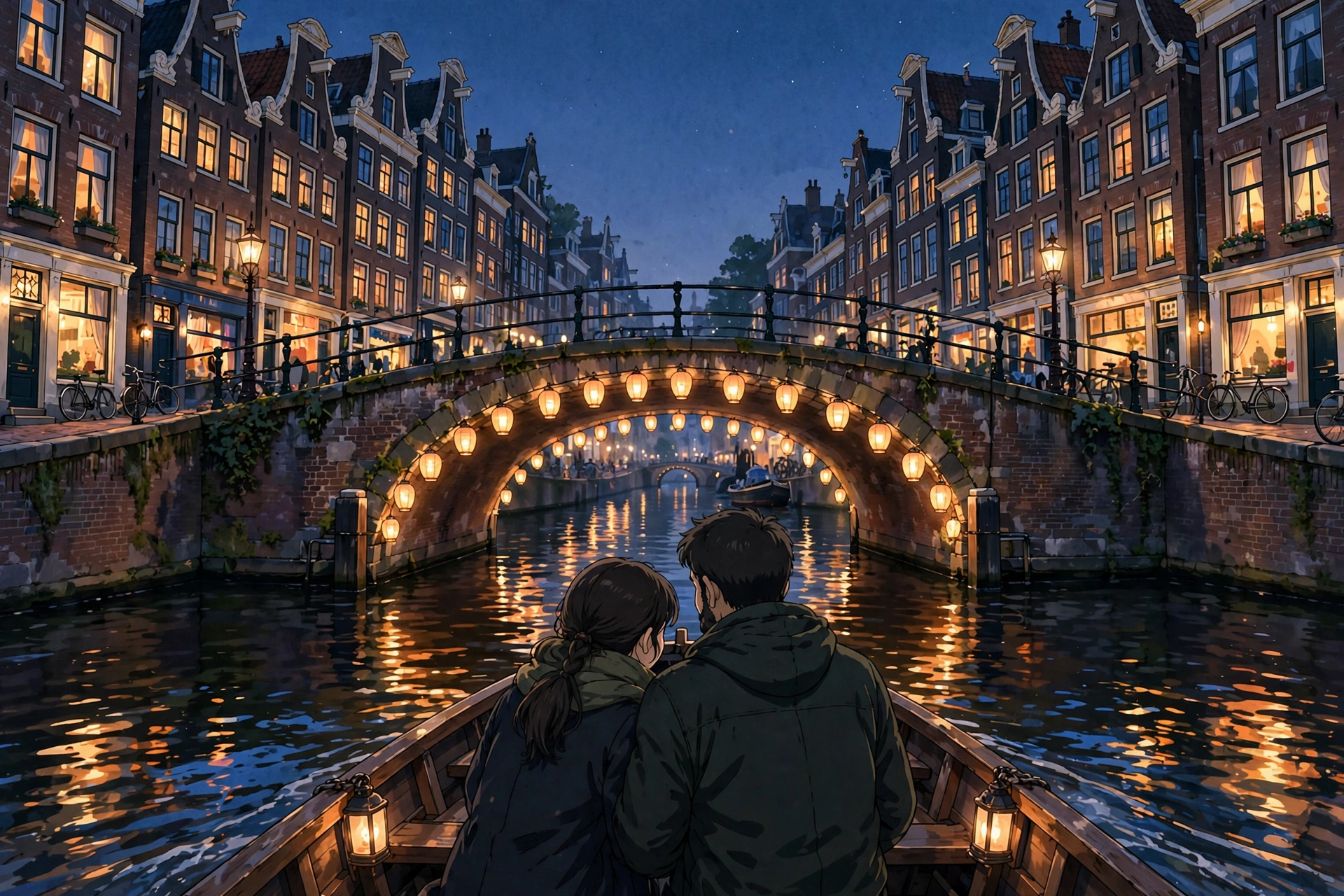
    Illustration of a couple in a boat gliding toward a stone canal bridge covered in glowing lanterns at night
    Gliding toward a lantern-lit bridge — the canal belt shows off after dark.

    Food and drinks on board

    Do not arrive hungry — but do not arrive full, either. The classic evening cruise pairing is a spread of Dutch snacks and bitterballen, served alongside unlimited drinks. It is grazing food, not dinner: enough to make the hour feel like an occasion rather than a tour.

    Most boats run a small bar on board with wine, beer, and soft drinks available to purchase, and some sailings include drinks in the ticket. Evening cruises in particular lean into the aperitivo mood — this is a night out, and the boats are dressed for it.

    Illustration of a couple on a canal boat sharing wine and a board of Dutch cheese, crackers, and fruit
    On board essentials: Dutch cheese, a glass of wine, and a moving view.

    If you keep dietary restrictions or are sailing with kids, it is worth a quick look at what is included before you book — options vary by boat, and some operators are better than others at catering to allergies or non-alcoholic preferences.

    Tips before you book

    1. Chase the sunset slot — Departures around sunset are the golden ticket: you get daylight, golden hour, and the bridge lights all in one sailing. In summer the sun sets late, so check local sunset times for your travel dates and pick accordingly.
    2. Choose your seat like it matters — it does — Open-deck seating gets you the best photos and the full breeze-and-lanterns experience, but evenings on the water run cooler than you would expect. Bring an extra layer either way, and head straight for the sides of the boat at the back — the steadiest views and the quickest exit at the end.
    3. Book ahead in peak season — Evening sailings are the most popular departures of the day, and the sunset slots fill first — especially on weekends and in summer. A day or two ahead is usually fine in shoulder season; in peak months, do not leave it to the same day.
    4. Arrive early, leave the front row to the ambitious — Get to the dock a little early so you are relaxed rather than rushed. The very front of the boat looks tempting but tends to be the bumpiest seat — and everyone behind you stands up for the Seven Bridges shot anyway.
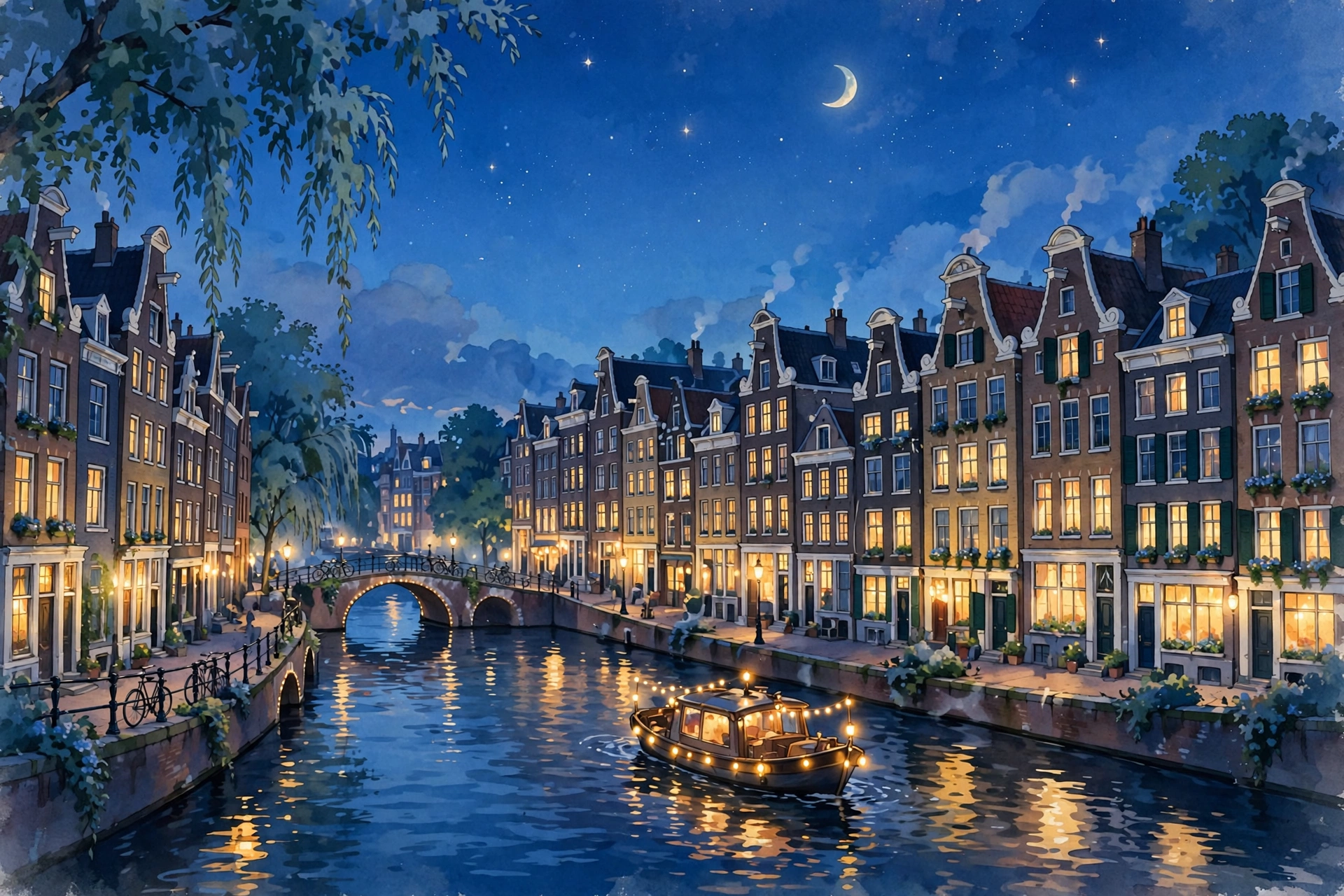
    Illustration of a moonlit Amsterdam canal at night with a warmly lit tour boat and glowing canal houses
    Last boat out: the canal belt under a crescent moon.

    Ready for your evening on the water?

    Pick your sunset departure, grab the cheese-and-wine sailing, and see Amsterdam the way it was meant to be seen. Free cancellation is typically available if plans change.

    Evening canal cruise FAQ

    How long does the evening cruise last?

    Most evening canal cruises run around one hour of sailing time. That is long enough to cover the main sights — the canal belt, the Jordaan, the Seven Bridges, the Skinny Bridge — without it ever feeling hurried.

    What should I wear on an evening cruise?

    Dress for the weather, then add one warm layer. Evenings on the water are consistently cooler than the streets, and a light jacket or sweater makes the difference between a cozy hour and a chilly one. There is no dress code — smart-casual is typical.

    Is the cruise suitable for kids?

    Yes — the boats are stable, the hour passes quickly, and most children love the bridges and reflections. Just book one of the earlier evening departures if little ones have an early bedtime, and note that the ticket includes unlimited drinks and Dutch snacks.

    What happens in bad weather?

    Boats run in most weather conditions, and covered seating is available on many vessels. In truly rough weather operators typically reschedule rather than sail — booking with a flexible cancellation policy is the simplest peace of mind.

    Affiliate disclosure: This post contains affiliate links, including GetYourGuide tour links. If you book through them, we may earn a commission at no additional cost to you. We only recommend experiences we would genuinely take ourselves.

    Illustrations in this post are original artwork in a dreamy animated style.